69Qs
Interview Questions
If you’re aiming for a PostgreSQL career, these PostgreSQL interview questions and answers can help you improve your expertise in the database. This article comprises basic to advanced-level questions with well-researched answers. By the end of the article, you will gain the necessary expertise to secure a promising role in database management.


PostgreSQL Interview Topics Covered
| Topic Area | Coverage |
| PostgreSQL Fundamentals | PostgreSQL architecture, features, schemas, tables, views, sequences, constraints, joins, normalization, triggers, primary/foreign keys, installation, and more. |
| PostgreSQL 18 & 19 Features | PostgreSQL19 Beta 2 highlights, PostgreSQL 18 enhancements, B-tree skip scan, OAuth 2.0 authentication, autovacuum enhancements, and replication improvements. |
| SQL Operations & Database Objects | Database creation, CRUD operations, indexes, partitioning, materialized views, stored procedures, CTEs, subqueries, JSON support, full-text search, and user-defined functions. |
| Performance Tuning & Optimization | Query optimization, indexing strategies, table bloat diagnosis, pg_stat_user_tables, PgBouncer, asynchronous I/O, parallel query execution, and more. |
| High Availability, Replication & Administration | Physical and logical replication, backup and recovery, pg_dump, WAL, pg_stat_replication, Citus, sharding, pgAdmin, monitoring, logging, security, and transaction management. |
| Security and Concurrency | MVCC, isolation levels, row-level security, encryption, concurrent transaction handling, ACID properties, locking, callbacks, and user privilege management. |
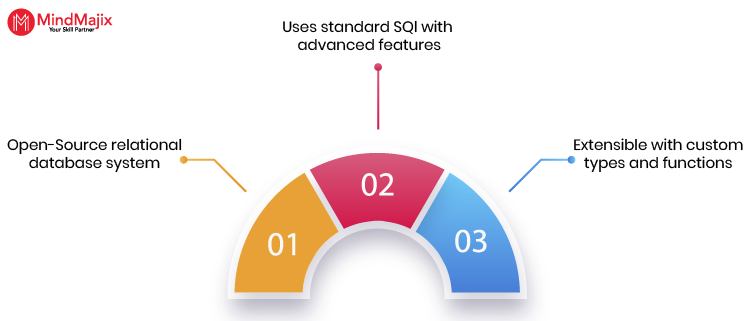
PostgreSQL is a feature-rich relational database management system. It is also called Postgres.
PostgreSQL stores, organises, and retrieves data effectively. It stores data in tables made up of rows and columns. It's used for web applications, business software, analytics, and location-based applications.
PostgreSQL uses Structured Query Language (SQL) to create, read, update, and delete data. It supports ACID compliance, ensuring transactions are reliable and consistent. You can add custom data types, functions, and extensions with PostgreSQL.
Asked by: TCS, Cognizant, Tech Mahindra
Below are the key features of PostgreSQL Beta 2:
Asynchronous I/O (AIO) in PostgreSQL 18 is a major performance enhancement.
AIO allows the database to send multiple disk read requests simultaneously. So it doesn't have to wait for each I/O operation to finish before starting the next one.
Asked by: Infosys, Wipro, HCL Tech
The following workloads benefit the most:
UUIDv7 is usually a better option than UUIDv4 for PostgreSQL primary keys. It offers global uniqueness along with time-based ordering.
UUIDv7 creates time-ordered UUIDs, enabling values to increase steadily over time. It solves the random-insert fragmentation issue in B-tree indexes using UUIDv4.
Let’s see the advantages of UUIDv7 in the following:
PostgreSQL 18 supports both stored and virtual generated columns. It allows you to automatically create column values from other columns.
A stored generated column calculates its value whenever a row is inserted or updated. It saves the result in the table. On the other hand, a virtual generated column is not stored in the table. PostgreSQL computes it each time it is referenced in a query.
Stored columns write results to disk, leading to faster reads but requiring more storage. On the other hand, virtual columns are calculated during reading, using no storage and reducing CPU costs per query.
Asked by: HCL Tech, Infosys, TCS
PostgreSQL enables you to:
Asked by: TCS
PostgreSQL uses the following methods:
Asked by: IBM, TCS, EPAM
A schema in PostgreSQL is a logical namespace that organizes database objects such as tables, views, functions, sequences, and types.
Asked by: Wipro, HCL Tech
Joins can be used to combine and retrieve records from two or more tables. PostgreSQL uses SQL joins to perform these operations.
Asked by: Cognizant, Accenture
We use constraints to ensure data integrity in tables and avoid unnecessary actions.
pgvector is an open-source PostgreSQL extension. It adds support for vector embeddings and similarity search directly in PostgreSQL.
A vector embedding is a numerical representation of data, such as text, images, and audio, produced by an AI model.
pgvector allows you to store high-dimensional vectors generated by AI models. We can perform semantic searches, recommendations, and retrieval-augmented generation (RAG) without needing a separate vector database.

PostgreSQL offers the following constraints:
Asked by: TCS
Asked by: Wipro, HCL Tech
A view displays the results of a query against one or more inherent tables. Views simplify complex queries. We can define views once and query directly.
Asked by: TCS, Wipro
In PostgreSQL, a sequence is a database object that generates a sequence of unique integers that we can use as default values for a column or as part of a primary key.
A tablespace is a disk location where we can store the data files for specific tables or indexes. It helps to have good control over disk usage and file placement.
In a database, normalization is a mechanism for creating or modifying databases to address inefficiencies in data storage, query processing, or data modification. In other words, normalization helps reduce data complexity and redundancy.
Asked by: Infosys, Cognizant, EPAM
A trigger is a database object that automatically calls a trigger function when an event happens.
Triggers are specifications that require a database to automatically execute a specific function whenever a particular kind of operation is performed. We can define triggers that execute before or after INSERT, UPDATE, or DELETE operations.
If a trigger event occurs, the trigger’s function is invoked at the appropriate time to handle the event.
Asked by: HCL Tech, TCS, Wipro, Capgemini
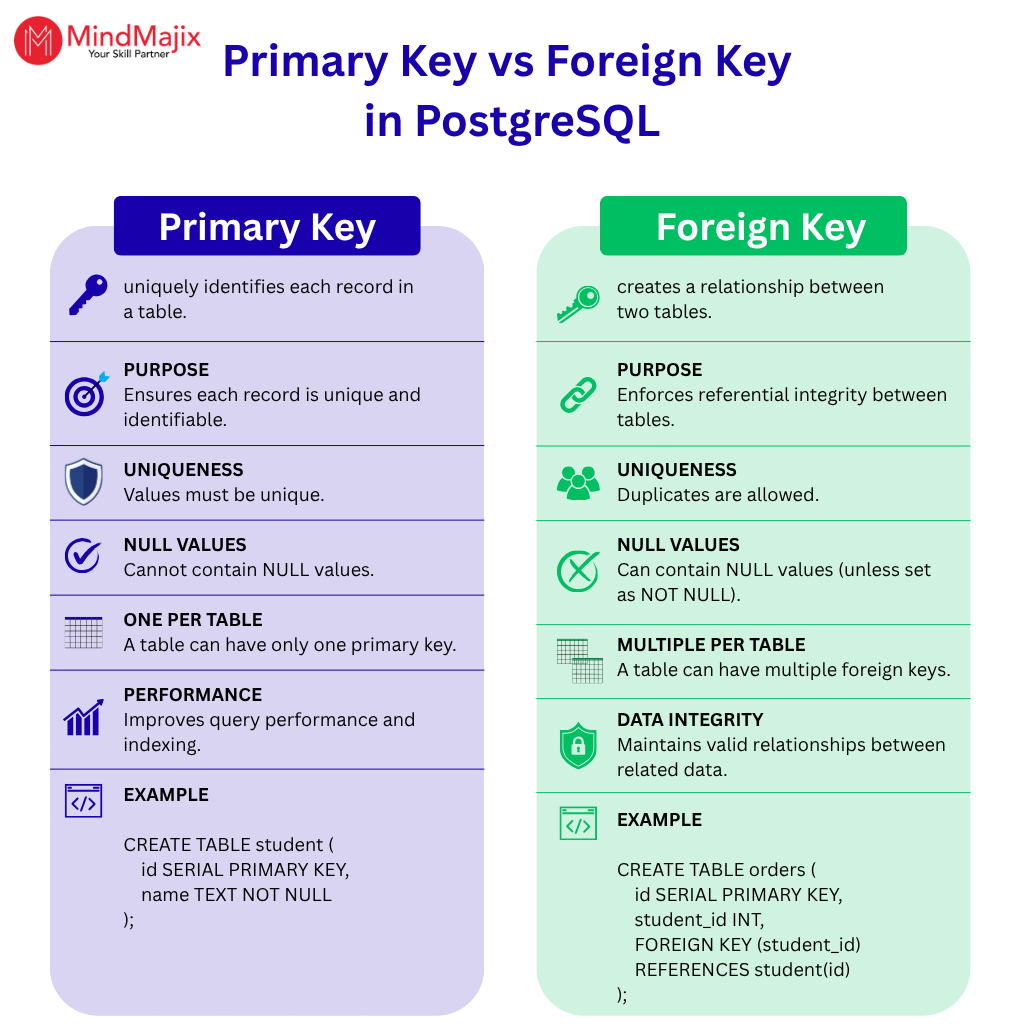
A primary key is a column or set of columns that uniquely identifies each row in a table.
A primary key ensures the integrity and uniqueness of the data in the table. Moreover, the values of primary key columns should be unique, and a primary key column must not include null values.
A primary key consists of unique values and non-null values, whereas a foreign key is shared between two or more tables.
Citus is now known as Microsoft Azure Cosmos DB for PostgreSQL.
Citus Data developed Citus and is now maintained by Microsoft. Citus is an extension for PostgreSQL that turns a single PostgreSQL database into a distributed database cluster. It is available as open source and serves as the distributed engine for Azure Cosmos DB for PostgreSQL.
Citus enables horizontal sharding of PostgreSQL across multiple nodes. It helps PostgreSQL scale horizontally by spreading data and queries across multiple servers, making it suitable for applications that exceed the limits of a single machine.
Below are the different isolation levels:
REPEATABLE READ cannot prevent all serialisation issues caused by concurrent transactions. SERIALIZABLE detects these issues and cancels one of the conflicting transactions, ensuring the database stays in a valid state.
Yes, we can run PostgreSQL on many cloud providers, including AWS, Google Cloud, and Azure.
Multi-Version Concurrency Control (MVCC) is an advanced feature of PostgreSQL.
MVCC improves database performance in multi-user scenarios. When we query a database, every transaction sees a snapshot of the database from some point in the past, regardless of the database's current state.
There are three primary commands for controlling transactions in PostgreSQL.
pgAdmin is the official tool for managing and developing PostgreSQL. It is used for database management, running queries, backing up and restoring data, monitoring, and handling server tasks.
Asked by: TCS, EPAM, HCL Tech
We can use the following strategies to enhance query performance:
Asked by: Capgemini, Cognizant, Infosys
The database callback functions are called PostgreSQL Triggers. When a specified database event occurs, PostgreSQL Triggers are automatically executed.
We hope that these basic questions have helped you become familiar with PostgreSQL.
B-tree skip scan is a query optimisation feature in PostgreSQL that improves performance for composite B-tree indexes.
B-tree skip scan allows PostgreSQL to use a multi-column B-tree index even if the query doesn't filter on the index's leading column(s). It enables efficient searches even when the query doesn't limit the leading indexed column.
This scan is helpful for large tables where the leading column has relatively few distinct values, and the later columns are selective. It enables skip scanning on multi-column indexes when the leading column is not in the WHERE clause.
Asked by: TCS, MindMajix, EPAM
OAuth 2.0 authentication in PostgreSQL allows modern integration with identity providers such as Okta, Azure AD, and Google without requiring external pgbouncer-level workarounds.
With PostgreSQL 18, the database server can authenticate users using OAuth 2.0 Bearer Tokens from trusted Identity Providers (IdPs). It makes authentication more efficient by enabling PostgreSQL to integrate directly with enterprise identity systems rather than relying on passwords or external authentication methods.
Asked by: Wipro, HCL Tech
A transaction is a sequence of database operations considered as a single logical unit. It ensures the atomicity, isolation, durability, and consistency properties of a group of associated database operations.
If any part of the transaction fails, all the modifications within the transaction can be rolled back, maintaining data integrity.
In PostgreSQL, we can handle transactions internally via auto-commit mode, where each statement is treated as a separate transaction. It can be done externally via the BEGIN, ROLLBACK, and COMMIT statements to define transaction boundaries.
PostgreSQL uses the CLUSTER command to physically reorganise a table by using an index.
Asked by: Wipro, Infosys
We can use the following methods for backing up PostgreSQL:
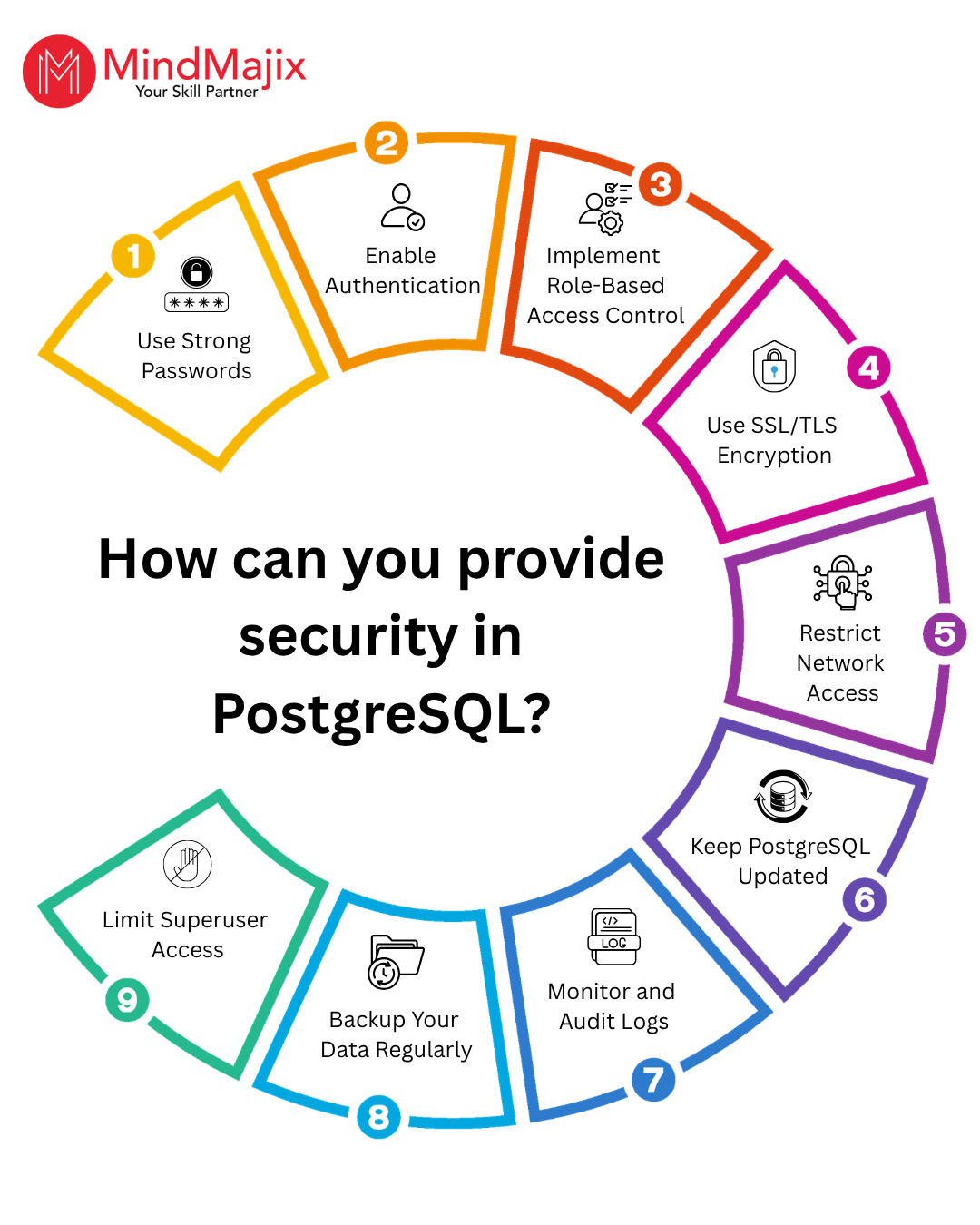
In PostgreSQL, security is addressed on various levels:
Asked by: EPAM, infosys, TCS
The “EXPLAIN” command displays the execution plan of the SQL statement. It includes how PostgreSQL processes the tables referenced in our statement, how it uses algorithms for complex operations, and how it estimates execution time.
We can use the “ANALYZE” command to get the actual time needed. We can use the “EXPLAIN ANALYZE” command to identify problems in complex queries and rewrite them to improve performance.
The “pg_dump” method enables us to create a text file with a group of SQL commands. When we run the commands on the PostgreSQL server, it will recreate the database in the same state as it was at the time of the dump.
In PostgreSQL, we use the “CREATE INDEX” statement to create an index. Here is an example:
The above statement will create an index on the “Employee” table.
A composite type in PostgreSQL lets you define custom data structures that store multiple values of different data types.
A composite type allows you to create user-defined types made up of the available data types. They are useful for grouping related data elements into a single entity. To define a Composite type, we can use the “CREATE TYPE” statement.
A materialised view in PostgreSQL is a database object that stores the results of the query as a physical table.
To create the materialized view, we can use the “CREATE MATERIALIZED VIEW” statement, defining the contents of the view. The materialized view is created or refreshed using a query.
By storing and precomputing results, you can achieve significant performance gains when querying materialized views. Unlike regular views, materialized views are precomputed and updated manually or periodically.
We can use the “INSERT INTO SELECT…” statement or the “COPY” command to perform bulk inserts effectively.
By using the INSERT INTO … SELECT statement, we can insert multiple rows in a single SQL statement. We can define the columns and their values in the “SELECT” clause. We need to repeat the “SELECT” statement for each row we want to insert.
This method is used when we need to insert data generated dynamically or retrieved from another table.
The “COPY” command reads data from the file specified by “data_file” and inserts it into the specified table. The file must include data in the format specified. This method is rapid and useful for huge datasets.
Asked by: TCS, Cognizant, HCL Tech
A stored procedure is a database object that binds a set of SQL statements. It enables you to perform complex operations and implement them as a unit.
The advantages of using stored procedures are:
For creating a stored procedure, you must execute CREATE PROCEDURE or CREATE FUNCTION statements.
A stored procedure will include input and output parameters, control flow logic, and local variables used in loops and conditionals. It will also return the result sets through the “OUT” or “RETURN TABLE” parameters.
The primary difference between CTE and Subquery lies in their usage and structure.
A CTE is a temporary result set defined in the query. We can create this result set using the "WITH" clause and refer to it multiple times in the same query. It enhances query readability and enables recursive queries. It is helpful when a complex query requires multiple subqueries that share a common table.
On the other hand, a subquery is a nested query in another query. We can use the subquery in the ‘WHERE', ‘HAVING’, or ‘FROM’ clauses. Subqueries are assessed first, and their results can be used in the outer query. We cannot reuse subqueries. It may impact query performance when subqueries are used excessively.
Both ‘UNION ALL’ and ‘UNION’ operators are used for combining the results of multiple ‘SELECT’ statements. But they differ in terms of their result sets and behavior.
The ‘UNION ALL’ operator combines the results of multiple ‘SELECT’ statements without removing duplicate rows. It contains all the rows from every ‘SELECT’ statement, including duplicates. This operator is faster than the ‘UNION’ statement because it does not require duplicate elimination.
On the other hand, the ‘UNION’ operator combines the results of multiple ‘SELECT’ statements and removes duplicate rows from the final result set. It performs a distinct operation, ensuring that unique rows are returned. This operation will incur overhead due to duplicate elimination.
Write-ahead logging enhances database reliability by recording changes before they are applied to the database.
Autovacuum is PostgreSQL's automatic maintenance process.
Autovacuum protects storage from dead tuples, updates table statistics, and helps prevent transaction ID wraparound. Without autovacuum, database performance gradually declines as tables gather dead rows, indexes become inefficient, and the query planner uses outdated statistics.
Common tuning scenarios:
1. Large OLTP Databases - Large transactional systems produce many updates and deletes.
Typical adjustments include the following:
These changes reduce table bloat and keep statistics up to date.
2. Write-heavy Tables - Change settings for each table individually when tables are heavily updated.
VACUUM in PostgreSQL is a critical process that reclaims disk space occupied by outdated data. The VACUUM process will identify reusable pages and free up space for future use.
It mainly performs the following two primary tasks:
PostgreSQL supports physical and logical replication to ensure data redundancy and high availability.
This method involves creating an exact copy of the main database by continuously streaming write-ahead logs to multiple standby servers. We can use the standby servers as read-only query failover targets if the primary server becomes unavailable.
Streaming Replication is a type of physical replication that is easy to set up and supports real-time, low-latency replication.
This method replicates changes to specific databases or tables, rather than to the entire database cluster. It uses publications and subscriptions to define which data must be replicated. It offers more flexibility but needs continuous monitoring.
Table bloat refers to the accumulation of unused space in PostgreSQL tables and indexes resulting from updates and deletes.
PostgreSQL uses MVCC (Multi-Version Concurrency Control), which doesn't allow dead tuples to be removed immediately. While VACUUM marks that space as reusable, it doesn’t actually shrink the table file on disk. Over time, this can make tables and indexes much larger than they need to be.
The following are the different methods that you can use to diagnose table bloat:
pg_stat_user_tables is a PostgreSQL system statistics view that gives you runtime information about user-defined tables.
pg_stat_user_tables is one of the most helpful views for tracking table activity, autovacuum, and the build-up of dead tuples. It is therefore crucial for identifying table bloat and checking if autovacuum is working effectively.
We can use pg_stat_user_tables to track dead tuples in the following ways.
The key columns are n_live_tup, n_dead_tup, last_autovacuum, last_autoanalyze, autovacuum_count, and vacuum_count.
PostgreSQL needs PgBouncer because creating and maintaining database connections can be costly.
In applications with many users, opening a new PostgreSQL connection for each request can consume significant CPU and memory. It can lower performance and hit the server's connection limit.
A connection pooler allows many client requests to share a smaller pool of persistent database connections.
Monitoring replication lag in PostgreSQL is crucial to keep standby servers in sync with the primary. Too much lag can lead to outdated reads, slow failover, and extended recovery times.
There are a few methods to monitor replication lag, depending on whether you are checking from the primary or the standby server.
PostgreSQL manages concurrent updates using its Multi-Version Concurrency Control (MVCC) mechanism.
MVCC enables multiple transactions to use the same data simultaneously without causing conflicts or blocking. PostgreSQL provides multiple isolation levels and locking mechanisms to handle concurrent updates and resolve conflicts.
We can select proper transaction isolation levels like REPEATABLE READ, READ COMMITTED, and SERIALIZABLE based on the application’s needs.
We can store, manipulate, and query JSON documents using various parameters and functions.
We can use the JSON and JSONB data types to store JSON data. JSONB offers binary storage and provides querying and indexing capabilities.
For querying JSON data, PostgreSQL provides functions such as:
These functions enable the extraction of specific values, navigation through JSON arrays and objects, and aggregation of JSON data.
We can also use operators such as -> and ->> to access JSON values and fields directly in SQL queries. Moreover, PostgreSQL supports indexing on JSONB columns, enabling effective querying of JSON data.
To perform logical replication, we must follow the steps below:
After that, PostgreSQL replicates the table or schema from the source database to the target database, keeping them synchronised.
PostgreSQL uses a client-server model to receive client requests, process them, and return results. It follows the process-per-connection approach.
Let’s explore more about the PostgreSQL Architecture
Postmaster serves as the supervisor in PostgreSQL, and it is the first process to start after PostgreSQL starts. It serves as the listener and is responsible for authorising and authenticating incoming client requests and for allocating a new Postgres connection for each request.
Shared Memory Segments are memory-backed caches reserved for transactions and maintenance activities. We can allocate various shared memory segments to perform different operations.
Background processes maintain consistency between disk and memory, enabling PostgreSQL to operate properly. Checkpointer, Background Writer, WAL Writer, and Physical Files are the background processes.
To implement parallel query execution, we can follow the steps below:
By configuring these settings and using the parallel-safe operators, PostgreSQL will parallelise query execution across worker processes, improving query performance.
PostgreSQL supports the following kinds of Indexes:
Every index type has its benefits and is ideal for different scenarios. The index type selection is based on your data's particular characteristics and requirements.
In PostgreSQL, the pg_stat_activity view provides information about the server's currently active sessions. It includes a row for every session linked to the database, containing details such as username, process ID, application name, and more.
It is generally used to monitor the database server, check for idle or blocked connections, identify long-running queries, and gather performance-related information. By querying this view, we can gain insights into current activity and the database's state, troubleshoot issues, optimise performance, and manage connections efficiently.
In PostgreSQL, a recursive query is a query that references its own output. It enables you to perform repetitive operations or traverse hierarchical or graph-like structures.
This query is built using the "WITH RECURSIVE" clause, also known as a Common Table Expression (CTE).
CTE includes two parts:
The anchor member serves as the base case, whereas the recursive member depends on the result of the previous iteration.
The recursive member enables you to query iteratively until a particular condition is satisfied. This recursion will enable you to perform hierarchical queries, traverse tree structures, and handle recursive data relationships.
A multi-version model enables multiple versions of the same data to exist in parallel. In contrast, a lock model allows only one version to be available at a time and locks the data while it is being edited.
The pg_stat_replication view provides information on the activity and status of standby servers in a streaming replication setup. By using this view, we can get the following details:
This view is used to monitor the synchronisation and health status of the standby servers and to ensure the overall stability of the replication setup.
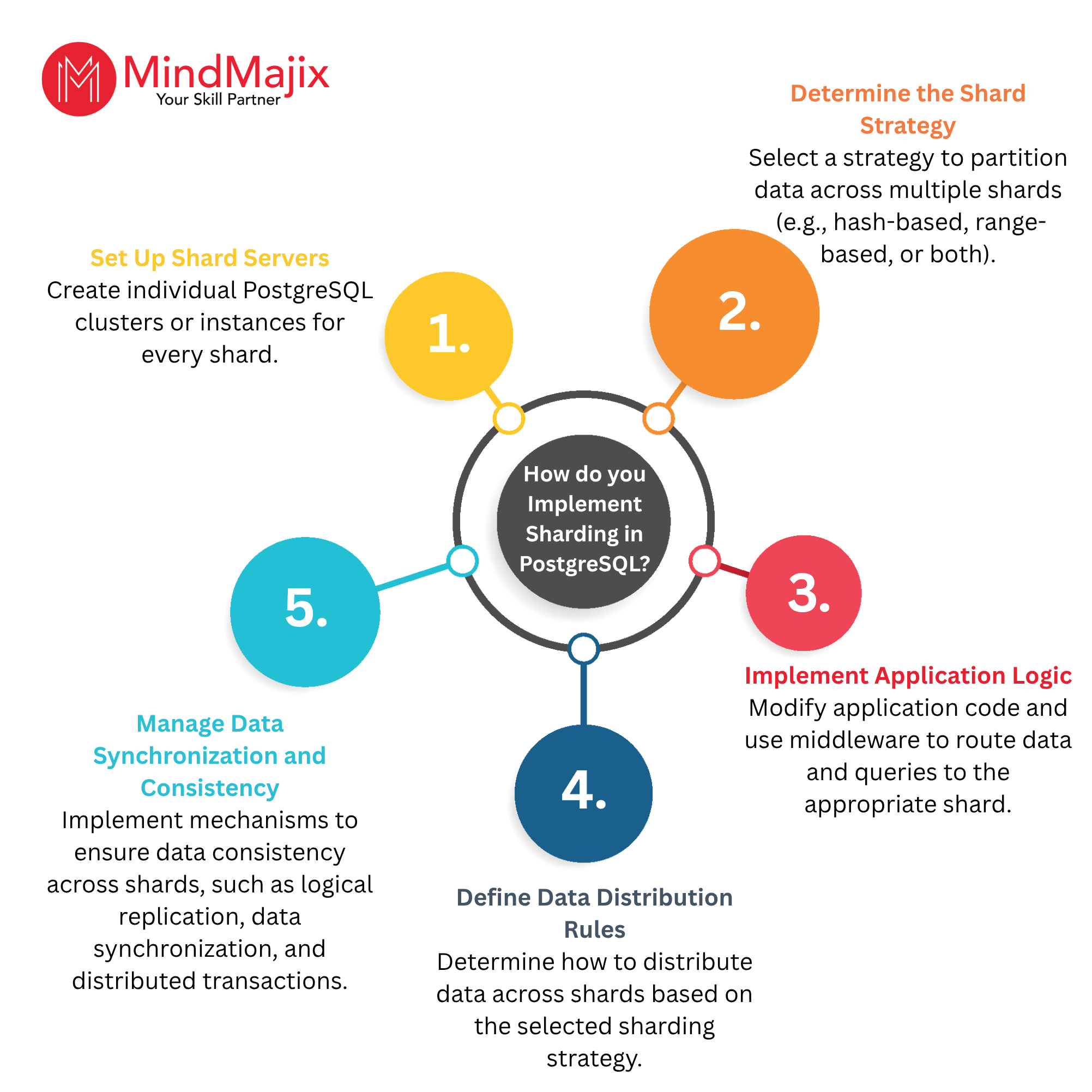
Sharding refers to horizontal partitioning of data across multiple shards or servers to distribute load and scale the database system.
We must follow these steps to implement sharding.
In PostgreSQL, row-level security enables us to limit access to rows in a table based on specific policies or conditions.
To implement row-level security, we have to follow these steps:
After implementing row-level security, PostgreSQL automatically applies security policies whenever queries are executed against the related table.
We can use the following techniques to implement data encryption:
Changes to execution plans, data volume, statistics, indexes, configuration, or system resources can cause slowdowns.
We can resolve this issue by using the methods below:
Choosing between B-tree and BRIN (Block Range Index) mainly depends on table size, data distribution, and query patterns. They are optimized for various workloads.
We can use a B-tree index for:
We can use BRIN for:
Go deeper with guided training, hands-on exercises, and interview-focused mentorship built for SQL roles.
 On-Job Support Service
Our work-support plans provide precise options as per your project tasks. Whether you are a newbie or an experienced professional seeking assistance in completing project tasks, we are here with the following plans to meet your custom needs:
| Name | Dates | |
|---|---|---|
| PostgreSQL Training | Sep 26 to Oct 11 | View Details |
| PostgreSQL Training | Sep 29 to Oct 14 | View Details |
| PostgreSQL Training | Oct 03 to Oct 18 | View Details |
| PostgreSQL Training | Oct 06 to Oct 21 | View Details |