
If you want a single reason why Identity Security careers are booming, look at the numbers. CyberArk's 2025 Identity Security Landscape found that machine identities now outnumber human ones by more than 80 to 1, and that 9 in 10 organizations suffered a successful identity-related breach in the past year.
According to 6figr, CyberArk and IAM engineers in India can get paid around 10-23 LPA, and experienced individuals can command an even higher package.
In this CyberArk tutorial, we will learn from core concepts to hands-on configuration.
So now, let’s get started.
Table of Contents:
- Privileged Access Management (PAM)
- What is CyberArk?
- History
- Benefits
- Components
- Architecture
- CyberArk Privilege Cloud (SaaS PAM)
- CyberArk Identity (Idaptive)
- Endpoint Privilege Manager (EPM)
- Cloud Entitlements Manager (CIEM)
- Vendor PAM
- Zero Trust and Just-in-Time (JIT) Access
- FAQs
- Conclusion
Privileged Access Management (PAM) – An Overview
Before understanding PAM, we’ll take a quick look at what a privileged account is.
A privileged account can access information such as social security numbers, credit card numbers, and PHI. Some of the privileged accounts in organizations include local admin accounts, privileged user accounts, domain admin accounts, emergency accounts, service accounts, and application accounts.
PAM is a cybersecurity strategy that helps you control, monitor, secure, and audit all privileged identities and activities across your IT landscape. The key players in PAM are people, processes, and technology.
Organizations implement PAM to avoid credential theft and privilege misuse. PAM is also known as Privileged Identity Management (PIM) and Privileged Access Security (PAS).
What is CyberArk?
CyberArk is an enterprise Identity Security Platform that secures every identity, human and machine alike, with privilege controls that stretch across cloud, hybrid, and on-premises systems.
The platform's own solution brief describes it as governance, access controls, intelligent privilege controls, and threat protection for all identities under one roof. In practice, that can be broken down into a few key pillars:
- Privileged Access Management (PAM): Centralized secure storage, rotation, and auditing of Privileged accounts and sessions.
- Endpoint Privilege Security: Remove local admin rights and implement least privilege on endpoints.
- Secrets Management: Storage of secrets, certificates, and API keys on applications and in DevOps pipelines.
- Cloud Entitlements (CIEM): Right-size permissions on cloud resources (AWS, Azure, GCP).
- Identity for Employees and Customers: SSO, adaptive MFA, and identity lifecycle.
- Machine Identity Management: Certificate and key lifecycle, added through the Venafi acquisition.
Put simply, CyberArk is now the layer that enforces an organization's whole identity security strategy, not just the place passwords go to sleep.
History of CyberArk
CyberArk was founded in 1999 in Petah Tikva, Israel, by Udi Mokady and Alon N. Cohen, with U.S. operations in Newton, Massachusetts. It started with the Digital Vault and became a publicly traded company on the NASDAQ (CYBR) in 2014.
Key acquisitions that expanded CyberArk into an identity security platform are:
- Viewfinity (2015): Added Endpoint Privilege Management (EPM).
- Conjur (2017): Introduced secrets management for applications and cloud-native services.
- Idaptive (2020): Added SSO, adaptive MFA, and lifecycle management, forming CyberArk Identity.
- Alero (renamed in 2021): Rebranded as Remote Access/Vendor PAM, rendering older references to Alero outdated.
- Venafi (2024): CyberArk's acquisition of Venafi is a landmark move that significantly expands its machine identity security capabilities.
- Palo Alto Networks (2026): Palo Alto Networks completed its acquisition of CyberArk in February 2026. CyberArk now anchors the identity security side of Palo Alto's platform.
Why CyberArk?
Organizations widely use the CyberArk platform to protect their identities from threats. Let’s break down the reasons here.
- CyberArk is a key player in securing critical accounts, including admin, root, and service accounts.
- It stores credentials, SSH keys, privileged accounts, and secrets in a hardened vault, significantly reducing risk.
- You can monitor, log, and audit privileged sessions to ensure compliance and security.
- You can secure application secrets, API keys, and machine identities in devops pipelines using Conjur.
CyberArk Benefits
With strong cybersecurity capabilities, CyberArk provides immense benefits to organizations. Some of these benefits include the following:
- Improves operational efficiency: With CyberArk, you don’t need to track passwords manually. CyberArk automates password monitoring, which significantly saves time.
- Eliminates redundancy: Since CyberArk allows admins to manage and update user privilege policies centrally. It eliminates redundancies in policy updates.
- Reduces risks: CyberArk centrally manages database passwords and ensures they are propagated to all dependent applications and services. This eliminates the risk of broken processes and prevents revenue loss with every password change.
- Enhanced security: CyberArk efficiently protects and manages privileged accounts and SSH keys against potential threats.
- Improved compliance: By leveraging CyberArk, companies can ensure accurate compliance with audit and regulatory requirements.
- Zero Trust Alignment: CyberArk enforces Zero Trust by ensuring every user, machine, and workload gets only the access they need, only when they need it and stays monitored every second it's active. This is supported in three ways, i.e., Least Privilege, JIT access, and Continuous verification.
CyberArk Components
The following are the components of CyberArk:
- Digital Vault: The Digital Vault is the most secure place on the CyberArk platform to store your confidential data. Since it is pre-configured, it is readily usable.
- Password Vault Web Access (PVWA): A web interface for managing privileged passwords. As part of password management, you can use PVWA to create new privileged passwords. The interface includes a dashboard that lets you view activity in CyberArk.
- Central Policy Manager (CPM): This component automatically changes existing passwords to new ones. It also provides password verification and reconciliation on remote machines.
- Privileged Session Manager (PSM): The PSM component provides access to privileged accounts from a central point. It also enables a control point to initiate privileged sessions.
- Privileged Session Manager for Web: This component enables companies to achieve a cohesive approach to securely accessing multiple applications, services, and cloud platforms.
- Identity Security Intelligence: On the modern platform, detection capabilities now reside within Identity Security Intelligence (ISI) — a shared service that handles continuous identity threat detection across the entire platform, not just self-hosted PAM. When the topic is analytics today, ISI is the term to reach for.
- Connector Server (for Privilege Cloud): It is what makes the SaaS model work. In Privilege Cloud, the vault lives in CyberArk's cloud, but sessions still have to reach systems sitting inside your network, and that's the gap the Connector Server fills.
CyberArk Architecture
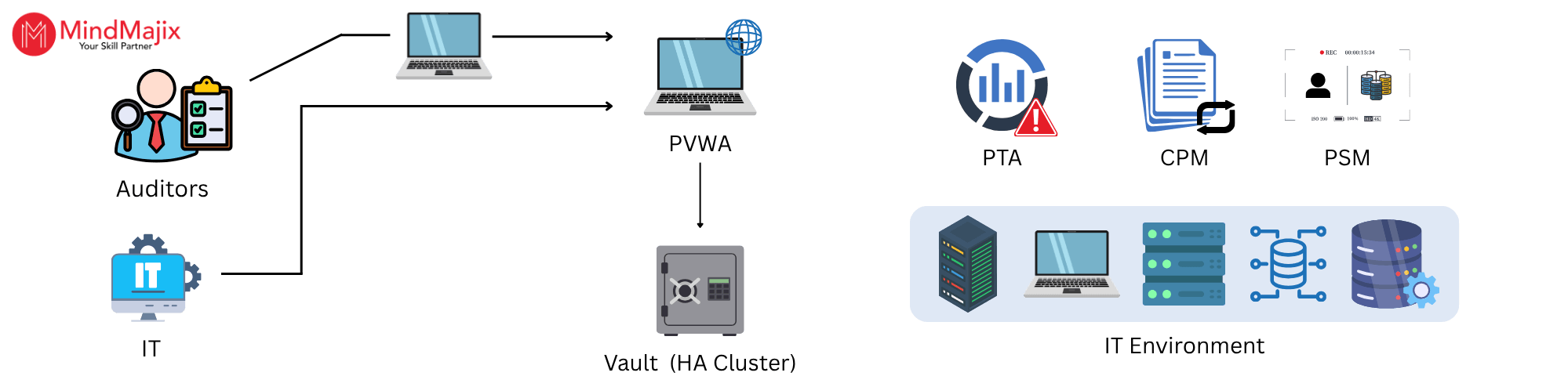
At its core, CyberArk comprises multiple components that provide highly secure solutions for storing and sharing passwords within the organization. These components include PVWA, Vault (HA cluster), PSM, PTA, and CPM.
Self-hosted Topology
At its simplest, CyberArk separates the Storage Engine (the Vault, where everything is stored and protected) from the Interface layer (which provides users and apps with controlled access). The two talk over CyberArk's own encrypted Vault protocol. A real enterprise build, though, is a lot more than one vault and one interface:
- Vault (HA cluster): A primary plus a standby vault for high availability, holding credentials, session recordings, and policy data.
- DR Vault: a Disaster Recovery vault in a separate location, replicating from the primary.
- PVWA Behind a Load Balancer: Several web-access servers fronted by a load balancer for resilience.
- PSM Cluster: Multiple session-manager servers to isolate, monitor, and record privileged sessions.
- CPM: The policy manager who rotates, verifies, and reconciles credentials on target systems.
SaaS Architecture (Privilege Cloud)
Privilege Cloud looks quite different and deserves its own diagram. CyberArk hosts and runs the vault in the cloud, and only a light footprint stays on your side.
- The vault and core services are delivered as SaaS.
- You deploy one or more Connector Servers to reach internal targets and host PSM/CPM functions.
- The day-to-day admin takes place in the portal rather than on-prem consoles.
Network Ports and Firewall Basics
It is constantly asked about in POCs and interviews, and you would benefit greatly from committing them to memory.
- Vault Communications uses the proprietary CyberArk protocol on TCP 1858
- PVWA access is on HTTPS ( TCP 443)
- PSM accesses through RDP ( TCP 3389), and PSM for SSH access is through TCP 22
- CPM communications with targets are on the ports that the targets' specific technology uses-these will range greatly and include, but not be limited to: SSH, RDP, any number of database ports, and so on.
Important Note: Make sure to review the exact list of supported ports in your specific CyberArk version's documentation, as supported services often change from one version of the software to the next.
High Availability and Disaster Recovery
HA & DR is simply not an option; in an enterprise rollout, it is imperative. There is no benefit to privileged access, which is most often required when an incident reveals a single point of failure.
- High Availability uses an active-passive Vault cluster so that, if one Vault dies, an automatically activated backup immediately goes online.
- Disaster Recovery uses a DR Vault at a remote site that continuously replicates data, enabling recovery after a site-wide incident.
- The interface tiers, such as PVWA and PSM, can be scaled out behind load balancers so that a single component going down does not prevent access for every user in the environment.

CyberArk Privilege Cloud (SaaS PAM)
Privilege Cloud is CyberArk's SaaS version of PAM, and for new customers, it's now the default way in. You get the same core capabilities as self-hosted — vaulting, rotation, session isolation, and monitoring. With Privilege Cloud, you're responsible only for lightweight Connector Servers. CyberArk runs the vault and backend services.
Privilege Cloud vs. Self-hosted PAM
The real difference is who owns what. A few points to keep straight:
- Operations: Self-hosted requires a dedicated in-house IT team responsible for patching, high availability/disaster recovery (HA/DR), and scaling. This is all largely managed by CyberArk in Privilege Cloud.
- Upgrades: You handle this in self-hosted PAM. Privilege Cloud keeps itself current automatically.
- Time to Value: Privilege Cloud usually goes live faster simply because there's far less to stand up.
CyberArk Identity (Idaptive) - An Overview
The other side of the CyberArk platform is the workforce and customer identity component, CyberArk Identity. CyberArk acquired these capabilities from Idaptive in 2020. CyberArk’s own description refers to it as providing "simple and secure access to all applications - on cloud, on-premises or hybrid." This is now a first-class citizen within CyberArk, not something " bolted on".
The components include Single Sign-On (SSO), Adaptive MFA, and Lifecycle Management.
- Single Sign-On (SSO): One secure login to cloud, mobile, and legacy apps.
- Adaptive MFA: Multi-factor authentication that ratchets up or down based on risk signals like location, device, and behavior.
- Lifecycle Management: Automatic provisioning and de-provisioning as people join, move, or leave.
Endpoint Privilege Manager (EPM) - An Overview
Endpoint Privilege Manager (EPM) ensures least privilege is enacted at the endpoint on Windows, Mac, or Linux machines. It's one of CyberArk's most-deployed products because it covers ground that PAM alone can't.
Why it's worth having:
- It removes standing local admin rights, which is a favorite entry and lateral movement vector for ransomware.
- It applies least privilege by elevating only specific approved actions rather than the entire account.
- It adds application control to block or limit untrusted software.
Cloud Entitlements Manager (CIEM) - An Overview
CyberArk's Cloud Infrastructure Entitlements Management (CIEM) product focuses on AWS, Azure, and GCP permissions. Overly generous cloud permissions have become among the top attack vectors primarily because you can amass thousands of unused cloud entitlements that nobody ever clears.
The problem and the fix:
- Cloud identities usually hold far more access than they ever use, creating wide, exploitable privilege.
- CIEM discovers and analyzes those entitlements across providers.
- It then recommends right-sizing them toward least privilege, often with AI help, without breaking the workloads that depend on them.
Vendor PAM (Formerly Alero) - An Overview
Vendor PAM, formerly known as Alero and also sold as Remote Access, secures access for third-party vendors, consultants, and contractors. Outsiders are a frequent source of breaches, and the old approach of VPNs plus shared credentials only made it worse.
Vendor PAM does it differently:
- Agentless and VPN-less: The vendor connects via the browser, there is no client software to install, and no need to join them to Active Directory.
- Biometric Authentication: Vendor identity verified by the phone's biometrics plus a time-sensitive, short-lived QR code.
- Just-in-Time Isolated Sessions: Access time-limited, observed and recorded, credentials do not hit the vendor's device.
Zero Trust and Just-in-Time (JIT) Access
Zero Trust and CyberArk's Role:
Zero Trust swaps implicit trust for constant, identity-based verification — never trust, always verify. Since privileged access is the most sensitive access there is, CyberArk ends up being the enforcement layer for Zero Trust at the identity level.
It supports the model through a few core ideas:
- Verify Explicitly: strong, adaptive authentication on every privileged request.
- Enforce Least Privilege: grant the minimum, scoped tightly to the task.
- Assume Breach: isolate, monitor, and record sessions to contain and make threats visible.
- Aim for Zero Standing Privileges: Eliminate always-on access wherever you can.
Just-in-Time (JIT) Access Provisioning
Just-in-Time access is one of the most important PAM ideas going into 2026. Instead of permanent ("standing") privileges, JIT hands out access that's temporary and time-bound. It created the moment it was needed and revoked the moment it wasn't.
The difference matters because what attackers exploit is standing privileges. Grant access only for the necessary task and time, and the attack surface decreases significantly. That's why JIT must be at the core of a mature, Zero-Trust-compliant PAM system.
CyberArk Implementation
CyberArk implementation can be done in different phases. It includes business and security requirements analysis, scope definition, solution launch and execution, risk mitigation plan, and company-wide execution.
You can get some insights about these phases from the following:
- Business and security requirements analysis: In this first phase, you need to identify specific security requirements, analyze risks, and outline controls. You also need to identify and prioritize privileged accounts, high-value and critical assets, and specify the controls and timelines.
- Scope definition: In the second phase, you need to specify the scope, define the stakeholders, and their responsibilities.
- Solution launch and execution: In the third phase, you will focus on architectural and solution design, as well as solution implementation.
- Risk mitigation plan: In the final phase, a small group of accounts must serve as a pilot to identify issues.
By completing these phases step by step, you can implement CyberArk security solutions in real-time IT environments.
Frequently Asked Questions
1. Is it easy for beginners to learn CyberArk?
Yes, beginners can learn CyberArk with the right guidance and structured training. An understanding of IT security and password management will strengthen your learning.
2. How long will it take to learn CyberArk?
You can learn the basics of CyberArk within 2–3 weeks. But becoming a job-ready professional typically takes a few months of structured learning and practice.
3. Does CyberArk access customer data?
CyberArk doesn’t access customer data unless it is necessary. It manages only data such as user identities, device information, and activity logs.
4. Does CyberArk support cloud platforms?
Yes, CyberArk supports both cloud and on-premises platforms. Privilege cloud and identity security are cloud-based solutions, whereas self-hosted PAM is an on-premises solution. It also integrates with AWS, Azure, and GCP.
5. What is the scope of CyberArk?
CyberArk professionals can secure jobs at MNCs with good salaries. According to Glassdoor, CyberArk Admins in India can earn between 4 LPA and 10 LPA. ZipRecruiter reports that they can earn between 27.5K USD and 209K USD in the USA.
Conclusion
We hope that you have learned CyberArk's key features and capabilities in this tutorial. You have also understood the CyberArk architecture, components, and implementation in detail.
If you wish to explore more about the CyberArk platform, you can enroll in a CyberArk course with MindMajix. It will help you gain deep expertise with the CyberArk tool and advance your career.
 On-Job Support Service
Online Work Support for your on-job roles.

Our work-support plans provide precise options as per your project tasks. Whether you are a newbie or an experienced professional seeking assistance in completing project tasks, we are here with the following plans to meet your custom needs:
- Pay Per Hour
- Pay Per Week
- Monthly
| Name | Dates | |
|---|---|---|
| CyberArk Training | Sep 19 to Oct 04 | View Details |
| CyberArk Training | Sep 22 to Oct 07 | View Details |
| CyberArk Training | Sep 26 to Oct 11 | View Details |
| CyberArk Training | Sep 29 to Oct 14 | View Details |

Ravindra Savaram is a Technical Lead at Mindmajix.com. His passion lies in writing articles on the most popular IT platforms including Machine learning, DevOps, Data Science, Artificial Intelligence, RPA, Deep Learning, and so on. You can stay up to date on all these technologies by following him on LinkedIn and Twitter.